
Sandbagged!

Photograph by Steve Barnett
Saturday, 30 October 2010
Basic Principles - Principle Number One

Thursday, 28 October 2010
Shopping list...
 |
| Click and then click again to see it properly! |
- Cock Badger Cape of the highest quality
- Cock Honey Dun (and all the Rusty, Brassy, Blue variants) ditto. If only I could find a genetic quality cape in the colours of this old Indian cape that I acquired nearly forty years ago.
- Fine black Ostrich herl preferably on the plume
- Size 26 (round not oval )silver braid (if I ever see it again)
- Anything else that turns the head and fills it with the inexplicable desire to possess and maybe even use it!
Regular Rod
Thursday, 21 October 2010
Anonymous said:
WHICH LINES COMES IN BROWN? WHICH WOULD YOU RECOMMEND?
I know of only one line that comes in a brown colour but, having obtained one, even that could be a better shade and finish, also the taper is not designed for dry fly fishing but is simply a conventional floating line that does most things adequately but is not ideal for the extremes that serious dry fly fishing can demand from the angler. That line is available from a vendor on the fly forum.
The best coloured lines I have used so far are the ones I had made, some time ago now, by Cortland but they were made up for me using one of their standard tapers and coatings simply coloured dark brown for me.
 The lines are being made with absolutely no compromises at all and no shortcuts in quality (there is no point in "spoiling the ship for a ha'porth of tar") so in a few weeks I will bring these lines onto the market. Their price will reflect their quality, but I'm sure anyone using them will be nothing less than delighted with them. I know I am already delighted with the prototype.
So to answer Anonymous: If you can wait a few weeks I will be able to recommend to you something then, much better than I can recommend right now.
Regular Rod
I know of only one line that comes in a brown colour but, having obtained one, even that could be a better shade and finish, also the taper is not designed for dry fly fishing but is simply a conventional floating line that does most things adequately but is not ideal for the extremes that serious dry fly fishing can demand from the angler. That line is available from a vendor on the fly forum.
The best coloured lines I have used so far are the ones I had made, some time ago now, by Cortland but they were made up for me using one of their standard tapers and coatings simply coloured dark brown for me.
I'm getting some lines made, designed from scratch to be perfect for dry fly fishing. The taper is such that it is capable of making the rod work and the cast turn over under control when fishing at very close quarters and with only a foot or so of fly line out of the tip ring. Yet, when a long cast is needed to the opposite bank and the fly has to be put into a tiny hole in the overhanging vegetation, the line will allow this. Its special low friction coating will let you shoot the line that little bit further, which can be essential if you have very limited space for your back cast, but you still need that bit of extra distance.
The colour is a matte, dark muddy brown and is exactly what I believe is the very best for avoiding all the problems of light coloured or shiny lines. The core is braided so you will be able to use the needle knot for attaching your leader.
 The lines are being made with absolutely no compromises at all and no shortcuts in quality (there is no point in "spoiling the ship for a ha'porth of tar") so in a few weeks I will bring these lines onto the market. Their price will reflect their quality, but I'm sure anyone using them will be nothing less than delighted with them. I know I am already delighted with the prototype.
Regular Rod
Friday, 15 October 2010
Facts and...
...Fancies
Fishing with nymphs, lures, spiders, traditional wets, Czech nymphs, buzzers, blobs and other things are not really my strengths. I have a go at some of them now and then but not enough to offer solid advice on any of these methods, or the equipment needed for them. However, for forty one years now I have certainly immersed myself in every little detail of dry fly fishing. Hence the brass neck to make a blog called... Dry Fly 'Expert'!
Fact:
Drab, brown fly lines ARE best for dry fly fishing!
Fancies:
“But a fly line on the water would be harder for the fish to see if it was the colour of the sky!”
“I like a white line because I can see it move if I get a take!”
“I catch fish and I use a line that is sky blue pink with yellow dots on!”
And so on...
Let me explain why I am adamant that a line in a drab, brown colour IS BEST FOR DRY FLY FISHING!
 It matters most of all during the casting process. Dry fly fishing demands frequent false casting. When the line is in the air, passing to and fro in the cast, if it is a pale colour it brightens its surroundings as it moves. In some circumstances this can be measured with a good quality light meter as used by traditional photographers, its needle moves as the line passes through its field of view. Trout can detect such changes. The line need not be seen by the trout but it will notice the change to the light made as the line passes by and very likely will cease rising. A drab, brown line makes no such noticeable change and so the trout is not put off its meal at the surface.
 Yes this is a nit picking detail but it is an important one. Yes you might be able to catch fish with a pale coloured line but consider this...
You have worked hard, made a considerable investment in time and money to get leave to fish. Bought tackle and clothes. Learnt how to use it all. Now here you are, hiding in the margin and you have carefully worked your way into position to get a better view of that “fish of a lifetime” rising a few yards up stream of you. Yes, the fish is bigger than you first thought and it looks to be in immaculate condition. It is rising and you have identified the flies it is eating. Brilliant! You just happen to have some perfect fakes of this fly in your box. You tuck yourself down and carefully change the fly to the type you have spotted. Everything is just right. The fish is rising four or five times a minute. Now is your chance to make that cast...
Why risk letting any of the tiniest details work against you?
Frederick the Great of Prussia once observed that “Genius is the infinite capacity for taking pains.”
Stopping your fly line from signalling to the fish that things are not normal is a pain worth taking.
Regular Rod
Fishing with nymphs, lures, spiders, traditional wets, Czech nymphs, buzzers, blobs and other things are not really my strengths. I have a go at some of them now and then but not enough to offer solid advice on any of these methods, or the equipment needed for them. However, for forty one years now I have certainly immersed myself in every little detail of dry fly fishing. Hence the brass neck to make a blog called... Dry Fly 'Expert'!
Fact:
Drab, brown fly lines ARE best for dry fly fishing!
Fancies:
“But a fly line on the water would be harder for the fish to see if it was the colour of the sky!”
“I like a white line because I can see it move if I get a take!”
“I catch fish and I use a line that is sky blue pink with yellow dots on!”
And so on...
Let me explain why I am adamant that a line in a drab, brown colour IS BEST FOR DRY FLY FISHING!
 It matters most of all during the casting process. Dry fly fishing demands frequent false casting. When the line is in the air, passing to and fro in the cast, if it is a pale colour it brightens its surroundings as it moves. In some circumstances this can be measured with a good quality light meter as used by traditional photographers, its needle moves as the line passes through its field of view. Trout can detect such changes. The line need not be seen by the trout but it will notice the change to the light made as the line passes by and very likely will cease rising. A drab, brown line makes no such noticeable change and so the trout is not put off its meal at the surface.
 Yes this is a nit picking detail but it is an important one. Yes you might be able to catch fish with a pale coloured line but consider this...
Why risk letting any of the tiniest details work against you?
Frederick the Great of Prussia once observed that “Genius is the infinite capacity for taking pains.”
Stopping your fly line from signalling to the fish that things are not normal is a pain worth taking.
Regular Rod
Thursday, 7 October 2010
Seasonal Endings...

Today was golden. See the picture for proof! Watching the rises it was easy to select the grayling although I did succumb to temptation thrice and deliberately cast to trout today as they were large fish and each one was rising in in its own particularly difficult place for the dry fly angler to cast to. Two flies were sacrificed to the tree Gods, but this is a small price to pay for attempting the theoretically "impossible".
If you want to carry on with the dry fly, now the trout are off the agenda, you need to get used to spotting grayling rises (or else go after chub if you are lucky enough to have them in your rivers). Grayling rise from the bottom of the river. This means they are coming to the flies almost vertically. When they turn down with a fly, their mouths, being underslung like barbel, have to be opened from underneath. This is coupled with a roll as the grayling turns itself the right way up again. These actions combine together usually (but not always) to make a bubble appear in the ring of the rise. This bubble in the rise form is the signal for you to watch closely and confirm or otherwise that the fish is indeed a grayling. If it is, you can then cast with confidence knowing that you are going to catch a grayling and NOT a trout!
Regular Rod
Sunday, 26 September 2010
Breaking the "Rule" to improve your chances
The "Rule" that usually is the best policy to adopt is quite simply "Match the Hatch"!
The recent Northerly winds and the low angle of the sun in the afternoons now conspire to ripple the surface with bright highlights, which contrast with the shaded water and present an awkward decision to the Dry Fly angler.
On days like today it can be a good idea to break the "Rule" and instead choose a fly you can see against the awkwardly lit surface. A black fly will show up well on the silvery water, but become tricky to see in the shade. A pale fly, to mimic the Pale Watery flies we have been getting on most days recently, will show up well on the shaded water, but be almost invisible on the bright, wind raised ripples.

What to do? Well I tied on a Double Badger today. The pale hackle showed up well enough in the shade and the dark body was clear to see in the bright ripples. I'm sure it was not as interesting to the grayling and the trout as a more imitative fly would have been, but at least I was striking when the fly was taken...
This tactic of breaking the "Match the Hatch Rule" has served me well for forty years, try it next time the fly is just proving too hard to keep in view and see if it serves you well too.
Regular Rod
The recent Northerly winds and the low angle of the sun in the afternoons now conspire to ripple the surface with bright highlights, which contrast with the shaded water and present an awkward decision to the Dry Fly angler.
On days like today it can be a good idea to break the "Rule" and instead choose a fly you can see against the awkwardly lit surface. A black fly will show up well on the silvery water, but become tricky to see in the shade. A pale fly, to mimic the Pale Watery flies we have been getting on most days recently, will show up well on the shaded water, but be almost invisible on the bright, wind raised ripples.

What to do? Well I tied on a Double Badger today. The pale hackle showed up well enough in the shade and the dark body was clear to see in the bright ripples. I'm sure it was not as interesting to the grayling and the trout as a more imitative fly would have been, but at least I was striking when the fly was taken...
This tactic of breaking the "Match the Hatch Rule" has served me well for forty years, try it next time the fly is just proving too hard to keep in view and see if it serves you well too.
Regular Rod
Saturday, 18 September 2010
Parentheses!
You will have already noticed that the fishing day now occurs between two distinct brackets (or parentheses) and that now these beginnings and endings are closing in on the angler like the two jaws of a vice, squashing the Sport into a shorter period each day...
A more gentle pair of parentheses around our human defined "trout season" is really one, not two events. It just happens to start towards the end of our trout season and ends a little while after the beginning of the next trout season. It is the appearance of that lovely winter ephemerid the Large Dark Olive. See that dun drifting down river from September to May? Check the wing position. If it is more vertical than the somewhat swept back wing of the Blue Winged Olive and the fly seems to be just short of half an inch long and its wings are grey, rather than bluish, and, if you can catch one to get a closer look, it has only two and not three tails, then there is a good chance it is a Large Dark Olive.
You can represent a Large Dark Olive very nicely with a variant of the Grey Duster tied on a slightly long shanked size 14 hook. The variation from the original is simply that the fly is dressed with a tail. As follows (just click on a picture to see it in full size):
A more gentle pair of parentheses around our human defined "trout season" is really one, not two events. It just happens to start towards the end of our trout season and ends a little while after the beginning of the next trout season. It is the appearance of that lovely winter ephemerid the Large Dark Olive. See that dun drifting down river from September to May? Check the wing position. If it is more vertical than the somewhat swept back wing of the Blue Winged Olive and the fly seems to be just short of half an inch long and its wings are grey, rather than bluish, and, if you can catch one to get a closer look, it has only two and not three tails, then there is a good chance it is a Large Dark Olive.
You can represent a Large Dark Olive very nicely with a variant of the Grey Duster tied on a slightly long shanked size 14 hook. The variation from the original is simply that the fly is dressed with a tail. As follows (just click on a picture to see it in full size):
 |
With the hook point masked by the vice run on a bed of light brown thread from a space behind the eye down to the start of the bend.
|
 |
Take a bunch of 12 or so hackle fibres from a large badger cock hackle and measure the length to be a little bigger than the body
|
 |
Swap hands with the fibres and tie them in at the hook bend
|
 |
Wind the thread along the hook shank tying in the fibres completely and making a bed of thread for winding the body over
|
 |
Like so
|
 |
Dub on a tiny pinch of blue underfur from a rabbit
|
 |
Wind the body, if all goes well the dubbed fur will be used up as you reach the end of the body
|
 |
Rib the body with open spiralled turns of the tying thread back to the front of the body and then wind forward four turns of thread on the bare hook shank to make a bed for tying in the hackle.
|
 |
Tie in a Badger Cock Hackle like this with the concave, dull side towards you. Wind the thread over the stripped portion of the stem until you reach the start of the body. Snip off the hackle stem as close as you can.
|
 |
Wind the hackle back to meet up with the body, six turns on a fly this size (14). Tie it in, tweak off the waste hackle tip and wind the thread quickly through the wound hackle to avoid trapping too many hackle fibres and make a whip finish. Varnish it and clear the eye of the hook whilst the varnish is still wet. The hackle tip left in your hackle pliers is a perfect pull-through for the job.
This fly is one of the most versatile patterns ever created. Without a tail it makes a great midge. In big sizes with some extra hackle it makes a first class representative of the Drake. Changing the colour of the materials allows you to copy a very wide variety of olives. It is easy to tie and fairly quick so you can soon have your box stocked with a fly that will help you catch fish on most days of the season.
Regular Rod
Postscript To help folks find suitably marked Badger Capes here is a picture to illustrate the ideal:  |
Sunday, 12 September 2010
Tactics for the back end of the season
 You should always hide yourself from the fish. Even Town fish will be easier to catch if they are not aware of your presence and activities.
This time of the season presents you with some great opportunities to take advantage of the high vegetation along the banks and revisit some of those bigger than average fish that you failed to make the acquaintance of earlier in the season.
Those overtrousers will protect you from the nettles and thistles so just sneak in there on your backside using your legs stretched out in front of you to open up little gaps in the margin for you to sit in, surrounded by plants that tower above your head and render you almost invisible to your chosen quarry. This approach makes some severe demands on your casting, but, if you get close and conduct most of your casting sideways over the river, the proposition is viable in most cases.
Regular Rod
Thursday, 9 September 2010
Now is the time for...
... grayling on the dry fly!
If you are out over the next few weeks and you find grayling rising, this fly is very reliable in bringing them up from amazing depths to snaffle this tiny creation. Sturdy's Fancy may be a "fancy" pattern, implying to many that it doesn't imitate anything but please believe me this is another very successful caricature style of fly that can be used to hint at all sorts of flies: reed smuts; midges; tiny terrestrials; even little sedge flies. Sturdy's Fancy can mimic them all.
It is best on small hooks - 16 down to 20 (for smaller than that the materials are not really suitable) with 16 and 18 being the most useful sizes. These small hooks force you to use fine tippet material 6x or even 7x so don't bang hard on the strike and to give yourself a bit of stretch, make the tippet at least a yard long with an ell or even a fathom being better if the wind conditions permit.
Here's how to make the Sturdy's Fancy:
 |
Put the hook in the vice shielding the point and wind on a short bed of purple thread, in this example it is Pearsall's purple Gossamer, same stuff as used in Kite's Imperial. |
 |
Lay on and tie in a piece of red floss with two turns of the thread. Danville's DRF Fire Orange (fluorescent red) nylon floss has been used here but the original was red silk floss. |
 |
Lay the forward pointing length of floss back over to the bend and trap it on top of the rearward pointing length on top of the hook. |
 |
| Carry on winding a bed of thread whilst at the same time tying down the floss to the bend |
 |
Cut the tail to a length about the same as the hook gape |
 |
Tie in a single peacock herl and keep the thread dangling at the bend. |
 |
Wind the herl to the front of the bed of thread and back to the dangling thread to make a body. Tie in the peacock herl at the bend and then rib the herl body with the thread in open spiral turns then keep winding forward four turns of thread on the hook shank to make a bed for the hackle stalk. |
 |
Tie in the hackle with the dull, concave side facing you, making a bed as you go for the hackle when you wind it. Trim off the waste hackle stalk. |
 |
Wind the hackle. Tie it in and wind the thread quickly through the hackle back to the eye to avoid trapping too many hackle fibres. Make a whip finish and varnish the head, cleaning out the eye whilst the varnish is still wet. The hackle tip left in your hackle pliers makes a good pull through for the job. |
You will be amazed by this fly if you have not already used it. Grayling will rise up from the bottom, through several feet of water to eat it. If you see them "missing" the fly, try a finer tippet, but do be careful on the strike.
Regular Rod
Saturday, 4 September 2010
Rooting for you!
 You might enjoy this little trick that I've used since being a lad hunting chub in overgrown places...
...except during periods of drought or near drought.
Low water? Well yes indeed. Of course all trees need roots to live. Bigger trees by the waters edge, like this double trunked alder, have bigger roots and some of them stretch out under and - during dry spells - above the water!
See below...

Plenty of room for a full grown woman or man to sit cross legged. It will keep your feet dry and provides a great fishing spot if you are happy to side cast up into the run where the fish are.

These spots are rarely fished efficiently, as most anglers will either struggle to dibble a fly to the fish from overhead or try from the opposite bank. Sitting there at close quarters makes the whole process very easy and very effective too.
Just make sure you check that the root mass can take your weight without lowering you into the water, backside first, as you sit there in pride of place casting up to fish that are quite unlikely to have ever been caught before.
Special tip... do your best to be stealthy when getting into position. If, however, in despite of your valiant efforts to be stealthy, you do scare the fish, simply make yourself comfortable and sit there quietly and wait for the fish to rise again. Then when they seem to be rising confidently (four times a minute is a pretty good indicator that they are no longer worried about your presence) make your first cast to the fish nearest to you...
Regular Rod
Thursday, 2 September 2010
Nondescript Sedge...
... or "NDS" to its friends!
Use a strong tippet in the larger sizes. Be ready for sudden, violent rises when there is not much going on.
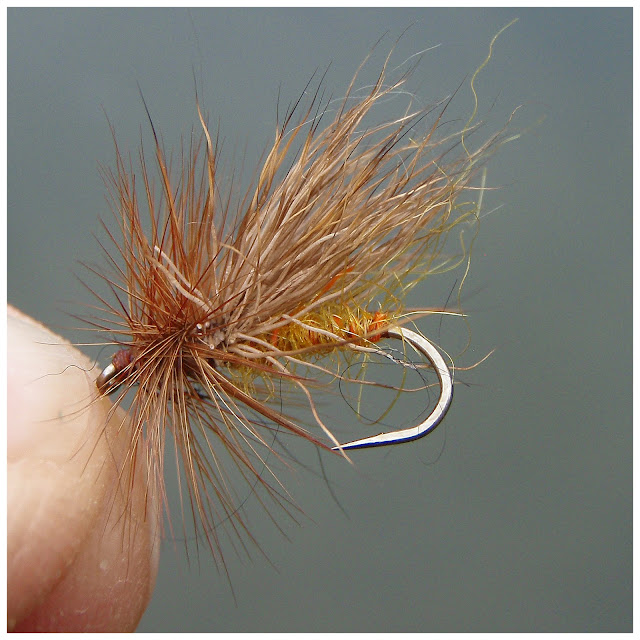
The hook sizes can vary from size 8 down to 14 depending on the sedge flies that are about. In the colour scheme here it seems to represent the Great Red Sedge quite well but it is not an exact match for anything. It hints at everything instead. Use pale materials and it makes a good moth for those all nighters in high summer when the scent of sweet rocket fills your nostrils and the air feels heavy with the prospects of good Sport...
Regular Rod
Use a strong tippet in the larger sizes. Be ready for sudden, violent rises when there is not much going on.

Use it when you expect to get a bit of drag. Twitch it on slow or still pools. It continues working even after the trout have trimmed its wing into a little stump of deer hair, so don't throw them away.
Last night I was told that you should tie six of these rather than five as folk will want more than one from you!
The hook sizes can vary from size 8 down to 14 depending on the sedge flies that are about. In the colour scheme here it seems to represent the Great Red Sedge quite well but it is not an exact match for anything. It hints at everything instead. Use pale materials and it makes a good moth for those all nighters in high summer when the scent of sweet rocket fills your nostrils and the air feels heavy with the prospects of good Sport...
 |
Put the hook in the vice masking the point and starting at the bend wind forward a bed of orange thread. I've used a size 12 hook here and Pearsalls Orange silk - yes the original orange for the Orange Partridge! Look just use the orange thread you like.
|
 |
Dub on a fairly generous pinch of cinnamon seal's fur - it's a mucky yellowy olive colour
|
 |
Wind the body, the seal's fur should be used up just as you reach the end of the body
|
 |
Rib the body with open spiralled turns of the thread and then continue for four turns to make a bed for the wing
|
 |
Take a bunch of deer hair and gauge it against the body and bend so the tips are roughly aligned with the hook bend
|
 |
Swap hands and hold the bunch of deer hair tight, clip off the waste prior to tying the bunch in
|
 |
Tighten up the turns and make the wing flare a little as you tie it tight next to the body
|
 |
Trim off the flared waste ends and dab a small spot of varnish on the remaining root ends of the deer hair. (I use Sally Hanson Hard as Nails.)
|
 |
Before the varnish has dried wind the thread forward to make a bed for the hackle stalk
|
 |
Tie in the red hackle ("brown" in America) like this with the concave, dull side of the hackle facing you and, in tying in the hackle stalk, wind a bed of thread ready for the hackle turns. Leave the thread dangling at the front of the body and wing.
|
 |
Wind the hackle, six or seven turns on a fly this size, and quickly wind the thread through the hackle to avoid trapping too many fibres. Then make a whip finish with a somewhat bolder head than you would do for an olive and then varnish the head and clear the eye whilst the varnish is still wet. I use the hackle point out of the hackle pliers as a pull-through.
It is a quick and easy fly to tie.
Woe Betide the lot of you if I find all the fish I'm after won't eat it anymore because they've already experienced it when you cast and caught them on it before!
|
Tuesday, 31 August 2010
Halt!
Who goes there? Friend or Foe?
Well, to the trout, there is no doubt you are foe. So don't let the little fellows on sentry duty raise the alarm when you crawl into position to cast to the nice BIG fellow you have been watching from downstream.
The photograph below (click on it for a bigger picture) shows you the situation, but it is difficult to see the little trout on sentry duty in the glide to the left of the foreground.
It is so very easy to fix your gaze on the big fish rising upstream that, as you make sure it doesn't see you, you can miss the presence of the little trout right under your nose. This leads to it dashing off in fear and if it heads upstream it will frighten the others in front of it and they in turn will charge upstream and frighten more and so on until your big fish is made aware that something is wrong and... Lo and Behold! The rises stop and it's as though there is not a fish in the river. This is why you need to creep about, why you need polarised spectacles and why you need to be on the lookout for the little fish, even though you are trying for the big'uns.
Your strategy in a pool like this is to catch the sentry first. Return him gently, but downstream of you and aimed towards a weedbed. So, instead of tearing off upriver, he makes for cover under the weeds. Then you can make that cast to the big fellow...
Of course they are not really on sentry duty. They just want the trout in front to not be there so they can move into the better place. Eventually, if all goes well for the sentry, it moves up through all the better places until, one day, he or she is the boss fish in the boss place - with sentries of his or her own to warn of danger.
Regular Rod
Well, to the trout, there is no doubt you are foe. So don't let the little fellows on sentry duty raise the alarm when you crawl into position to cast to the nice BIG fellow you have been watching from downstream.
The photograph below (click on it for a bigger picture) shows you the situation, but it is difficult to see the little trout on sentry duty in the glide to the left of the foreground.
 |
Sentry above here ^ |
Your strategy in a pool like this is to catch the sentry first. Return him gently, but downstream of you and aimed towards a weedbed. So, instead of tearing off upriver, he makes for cover under the weeds. Then you can make that cast to the big fellow...
Of course they are not really on sentry duty. They just want the trout in front to not be there so they can move into the better place. Eventually, if all goes well for the sentry, it moves up through all the better places until, one day, he or she is the boss fish in the boss place - with sentries of his or her own to warn of danger.
Regular Rod
Saturday, 28 August 2010
Poly Prop Sherry...
...before it's too late again!
The first post was about using this fly. The most recent was about still using it even though its time will shortly be drawing to a close for this season. It dawned on me you might appreciate how to make the thing so you can have a go "before it's too late again".
Make five of these at a time. One for the fish (we all make mistakes), one for the trees (we all make more mistakes), one on your tippet, one for your box and one for the angler who comes over and says "By Gum! You're doing well tonight! What fly are you using?"
Regular Rod
The first post was about using this fly. The most recent was about still using it even though its time will shortly be drawing to a close for this season. It dawned on me you might appreciate how to make the thing so you can have a go "before it's too late again".
 |
| Put the hook in the vice hiding the point and whip a little bump of orange thread at the bend |
 |
| Tie in a good bunch of white cock hackle fibres in front of the bump and take the turns towards the bump, tying the fibres down tight to the bump, so the hackle fibres splay out. |
 |
| Wind the thread up to the front of where the body will be, making a coarse bed of thread as you do so. |
 |
| Take one strand (there are four to a card) of Tiemco Aero Dry Wing in Medium Dun and trap it on the top of the hook by two turns of the thread, leaving a long strand over the hook bend and a short strand over the eye. |
 |
| Hold the long strand towards you at a right angle to the hook and take a diagonal turn over it and round the hook |
 |
| Make figure of eight turns to anchor the wing both sides at right angles to the hook. With the thread dangling in front of the wing dub on a small amount of Hot Orange seal's fur quite tightly. |
 |
| Starting in front of the wing wind the dubbed thread of Hot Orange seal's fur down the hook finishing at the start of the tail. It always looks rough and too fat at this stage. |
 |
| Rib the body with the thread right back up to just behind the eye and make a whip finish and cut off the thread. |
 |
| Get hold of the wings and carefully pull them back over the hook bend. Gauge the length of the wings to about the distance from the wing roots to a point about mid-way through the hook bend and snip off the excess wing length with one cut of the scissors. |
 |
| The fly should look like this at this stage (nearly finished). |
 |
| Now take the fly out of the vice. Hold it like this by the wings. Snip off all the extraneous bits of seal's fur to make a thin body that has lots of cut ends of fur round its edges to catch the light. |
 |
| Varnish the whip finish and clean out the eye whilst the varnish is still wet. Et Voila! The finished "Poly Prop Sherry" (or "PPS" to its friends). |
Make five of these at a time. One for the fish (we all make mistakes), one for the trees (we all make more mistakes), one on your tippet, one for your box and one for the angler who comes over and says "By Gum! You're doing well tonight! What fly are you using?"
Regular Rod
Subscribe to:
Posts (Atom)