Sandbagged!

Sandbagged!
Photograph by Steve Barnett

Thursday, 24 February 2011

Stephen asked...

"My question is ' Why no wings on your flies thus far, is tradition overtaken by efficacy and common sense'?


I realise a number of gifted anglers of the past, Richard Walker being but one, avoided tying wings on Dry flies, suggested that after 30 mins fishing, the wings would be a mess. Is this your reasoning?"

Ironically the first fly I ever tied had two badger hackle point wings and was tied, in an engineer's vice on the kitchen table, according to instructions by Dick Walker in one of his letters to Maurice Ingham in that wonderful book "Drop Me A Line"! 

It worked and led to a lifetime of dry fly fishing...

To answer the question properly:  I do use wings on some flies but only one of my flies uses a traditional type of wing and even that is very "North Country" in style being tied leaning forward over the hook eye.  This is a traditional pattern for the river Dove that Staffordshire angler, Tony Bridgett, taught me.  It is called a "Cock Winged Dun" the word cock meaning that the wing is cocked forward, not that the feather comes from a cock.  It comes from a starling's wing actually.  This is a very good fly to see on a dappled water as is commonly found on many parts of the river Dove.


Click on the picture to see it larger, click it again to see it at maximum size
 The rest of my winged flies are either hairwinged, like the mayflies and sedge in the picture, or else they are made of polypropylene and are usually meant to represent spinners after they have finished egg laying.

Traditional split winged floaters as well as being beautiful, have the added advantage of being easy to see on the water but hackled flies seem to work better for me.  They are quicker to tie and keep their shape better than the traditional feather fibre winged offerings.

What do you do about wings on your flies?

Regular Rod

Saturday, 19 February 2011

Still approaching but...

What fly to put on?

Aha!   Don't get caught out by that question.  You can make an intelligent guess what to put on but remember what we have been considering in the approach.  Let the results of your observations determine the fly you will start the season with...

Yes put something on before you start. (Ooh very Norman Evans!)  Do be ready though to change it immediately you have been able to reconnoitre the water.

Nevertheless, we can start guessing.
 
In spring we often have the benefit of the end of the Large Dark Olive's season.  The Large Dark Olive (or LDO) is a true winter fly putting in its first appearances towards the end of a typical trout season.  It then carries on appearing to conduct its affairs of the air world until the early part of May.  It is worth carrying something to represent it in the Dun or Sub Imago stage of its life.  There are lots of artificials that can be used for this fakery.  You already you know of the Grey Duster

Here is another, very well known fly that can be tied to make a pretty good effort at the real thing.  You will find it particularly effective when there is some sunshine around, under which conditions it seems to have the edge over the Grey Duster.  It is the Kite's Imperial and was invented by Oliver Kite, I believe inspired at the time by a traditional Welsh pattern.  The original dressing asked for a thorax made by doubling the body material, heron herl, back and forward again as is done with a Pheasant Tail Nymph.  The version here is slightly easier to tie as experience has shown that a thorax is better hinted at by the list in the hackle.

The materials are worthy of consideration.  The hackles specified are Honey Dun but that choice is almost certainly for making Kite's Imperials to mimic the Blue Winged Olive rather than the LDO.  By using subtle variations of hackle you can make Kite's Imperial represent many different types of upwinged naturals.  For the LDO we will use Dark Honey Dun hackles, which in this case we are using the cape in the bottom right corner of the picture on the right.


Here are the materials you will need for a Kite's Imperial to represent a Large Dark Olive.  They consist of: the Dark Honey Dun cape; a Heron hackle with long herls; fine gold wire size 26 gauge is good; purple tying thread and for the size of fly we are intending to fake we will use a size 14 hook.

Don't forget if you use this fly for other upwinged flies such as a Blue Winged Olive you will use a more orangey cape.  If you tie some little versions for the Iron Blue Dun, you would use a very dark cape and maybe use heron herl from a wing primary that are a lovely deep slate blue.  Heron feathers cannot be bought and sold in the UK.  You have to find your own.  You need to look around for the feathers on the ground under their heronries or, typically in a hard winter, look for corpses usually washed up on the bank after the floods.  It is Nature's way that for these splendid birds life is pretty tough in winter.  That is probably why you rarely see herons that are not in the peak of condition, only the strongest survive to pass on their genes.


Here is how to tie it:

Run on a bed of the purple thread, well waxed to where the bend starts

Take a large hackle from the cape, tear off a good bunch of fibres and tie them in to make a tail a little longer than the hook

Bite off a length of the ribbing wire and tie it in as shewn (biting it off makes a little hook on the end that will grip well when tied in fully)

Take five herls and nip about 5mm off the thin ends.  Tie them in as shewn.

Wind a bed of touching turns back to the starting position tying the tails, herls and wire in tightly as you go.  Trim off the waste ends of the hackle fibres used to make the tail.

Wind the herls up to the start of the body and tie them in tightly.

Wind the gold wire ribbing in open spiralled turns in the opposite direction to the way the herls were wound.  Tie in the wire tightly and rock the wire back and forth until it fatigues and breaks away.  This makes another little hook on the end of the wire and two more tight turns of thread will anchor it very firmly by that hook.

Trim away the herls and wind the thread forward two or three more turns to make a bed for the hackle stalk.


Tie in the hackle with the concave side facing you and the stripped stalk pointing to the rear of the fly.  The tying in turns make a neat bed for you to wind the hackle.

Wind the hackle, six turns is good for a hook this size (14).  Tie it in and wind the thread quickly through the hackle to avoid trapping too many fibres (do it slowly and you will catch in lots of hackle fibres, so do it quickly) finishing with the thread just behind the hook eye.  Tweak off the hackle tip held in your hackle pliers.  Make a neat whip finish of three or four turns.  Cut off the thread. Varnish the head well.  Sally Hanson Hard as Nails is good.  Whilst the varnish is still wet take the hackle tip out of the pliers and use it as a pull-through to clean out the surplus varnish from the hook eye.

The finished Kite's Imperial
The most useful sizes for Kite's Imperial through the season are 14, 16 and 18 but do try a few extreme sizes like 10, 12 and 20. The LDO can seem right on a 14 one day and then another you might need a 12!

This is a fine fly and has caught me well over an Imperial Ton of fish in the past forty odd years.  Here is an extract from an old journal of mine that I had posted on a forum six years ago this spring.  It illustrates the efficacy of this splendid fly quite well.

5th May 2005
 "On what was intended to be a saunter up to Black Barn Weir and the end of the day, I peeped over some sedges that were already high enough to shield the right side of a very long and slow eddy. A rise had me genuflecting immediately. The saunter forgotten I slid into a vantage spot to sit and watch awhile. Several fish were rising. Two or three in the central main downstream current but...

 
Less than a yard from my bank head facing downriver but actually into the eddy's upstream current was a monster of a brown trout. The light was awkward but I could see it was a cock fish and that it was longer than my arm (and much fatter than my arm). What was it eating? Well it was eating anything and everything, midges, duns, bits of stuff I couldn't see, everything! I had on a Kite's Imperial tied on a Drennan Super Specialist carp/barbel hook nominally a size 14 but really between a normal 16 and 18. The big fish had a beat. It went downriver a yard from the bank passing under some dead stalks from last year's marginal fringe. It carried on down a good 10 yards then turned left coming back upriver, on the edge of the current proper, passing me and turning to start his mopping up operations all over again. I decided to cast as he reached the overhanging dead stalks. He tilted, levelled off and then I struck...

 
 He fought quite well but I was able to keep him turning and turning until he was turning above my net and that was that. The hook was never going to come out without human intervention, it being firmly in the right hand scissors. Out it came and wasting no time I decided to weigh him. I can guess fish up to 3 pounds quite well but I don't have fish of this size often enough to trust my guesses.

 
The scales showed me 8¼ lbs. So in my head subtracting 1lbs 2oz for the wet net my beautiful brown trout was 7lbs 2oz, or was it? After a careful release and the butterflies in my stomach settling down I picked up my scales to put them away. Aargh! The dratted things weren't zeroed properly. In fact they were fast by quite a bit. I ended up guessing that I'd been a good half pound out. It was therefore "only" 6½ lbs or so. Who cares? It was a splendid fish and after all, "Numbers don't matter anyway" do they?

 
The saunter was reinstated. A few fish were caught in the Black barn Weirpool. A pleasant 10 minutes were spent chatting with a young man from Congleton who had had a good day. A last cast at the junction pool by the big island and then home.

 
The evening had been a delight and reinforced my long held view that this river, on which I have been taught so very much, is one of the very best places to be. If they won't hang my carcase over it when I die (so the maggots can drip out and feed the fish) maybe they'll use my fishing clothes to reinforce the bank somewhere? Anything like that will do. I just don't like leaving the place behind!" 


Regular Rod


Thursday, 27 January 2011

Approaching some more...


So you have carefully positioned yourself somewhere downstream where you can watch and wait awhile.  You have enjoyed some of the wildlife in and around the river.  Maybe watched a little fry like the one pictured earlier?  Sometimes this can be heartbreaking.  I was once watching a little tiny troutlet minding his own business, intercepting the occasional food item.  When, from under a fist-sized stone, without any warning and so suddenly it made me jump, a Bullhead darted foward to engulf my little friend in one gulp! The bullhead quickly disappeared, back under the stone from whence it had launched its deadly, Monkfish-like, attack. 

If the bigger fish showed themselves no doubt you were able to enjoy some Sport with them, but now you decide it is time to start working your way upstream.  Go slowly.  Stop a lot and keep soaking it all in.  Look around for those fish that will turn you into stone if they see you.  Keep low when near the water.  As you approach a new run, or pool, or riffle, or eddy remember to watch out for those fish in the edge.  It does no harm to stop and sit down cross legged on a rock in the water's edge or loll on the grass and do a mini-watch and wait as if starting all over again.  Take your time to enjoy the pageant as it unfolds before you.

Here is a picture (click it twice to get it as big as possible) taken whilst on a mini-watch.  If anything the view point is too high as I held the camera up to get a better sight of what was going on..  It is hard to see but there are at least two rises happening as the picture was taken.  They are on the right of the faster water in  mid-stream.  The thing is, I had already seen two very decent fish rising in the fast water but was faced with another of those sentry-on-guard adventures that we looked at together last summer.  If the writing is too small under the picture by the way, just do Ctrl and + until it is big enough for you to read it easily.

So staying sat down we catch the nearer fish then the next one and this allows us chance to fish for the fish in the fast water.  All this is done on your waterproofed backside.  Do get into the habit of fishing whilst sitting down.  It sends some folk into a shocked state when they see you doing this but they start doing it too when they see your success rate.  I was once asked to fish a spot for a photograph for a magazine.  We were on the Derbyshire Wye together.  I crept into position and fished.  After a few moments my writer friend came over and said "You will have to stand up for the photograph!"  "Why?"  "You look as if you are Coarse Fishing!"  This got me laughing so much he saw the funny side of things, abandoned that photographic opportunity and later found a composition that was much better and yes, I was sitting, huddled up in the hemp agrimony and the figwort and hidden from the fish.  If you are a Coarse angler please do not forget your hard learned habits of concealment just because you are now dry fly fishing.

Those nice fish in the fast water?  Well I managed one of them.  It was not particularly big but it is probably the most beautiful brown trout in the world, well my little world anyway.  Here it is.  Who says, "Only rainbow trout have spots on their tails?" 

Do you recognise this trout's exquisite markings on its sides?  They form the front cover of the 'EXPERT' information booklet that comes with each 'EXPERT' Dry Fly Line...

We'll experiment with flies next time.  Oh, in the meantime, if you have any observations or questions to put, don't hesitate to use the comment facility.  You will get my undivided attention!

Regular Rod


Wednesday, 19 January 2011

Anonymous (well it was Stephen really) said:


"I fully understand the value of thorough reconnaissance, but like a lot of anglers I have to travel a fair distance to follow my sport. How long do I wait before I go searching for the Trout when they are not rising and what tactics do you use to do so?"

The real answer to the first part of this very reasonable question is: "It all depends..."

It depends on: what time of year it is; what time of day you are starting; the nature of the water you are fishing; and what you can see already now you are there.

At the beginning and end of the season the best of the fishing day is usually compressed into a short time of about three or four hours in the centre of the daylight hours.  This is variable though, as weather conditions can change and a sudden warm spell occur that can extend the day until dark as flies and fish make the most of these special occasions, but generally you will be doing most of your fishing in that central part of these shorter days.  So if you have arrived at the at the waterside by 11:00 you will be waiting a short time and if no rises are evident within half an hour you would do well to, slowly, go-a-hunting, working your way upstream until you find either rising fish or see a fish on station that looks like it might come up to your artificial.

In high summer the dry fly fishing day is more complicated but we are blessed with more hours of opportunity.  Complicated in that it starts and stops and starts again and stops and starts again...

Get there before dawn and you will very likely find that there are fish rising.  These have probably been feeding all night.  You would start fishing immediately in these circumstances, but an hour or so after dawn everything goes quiet.  This has prompted me to think that when we say, at around 08:30 or so, "We are too early!" we are kidding ourselves.  We are actually too late, for the first activity of the day that is.

At the "normal" time of starting, mid-morning, you will probably have to wait a while before any serious hatch, and consequent rise, gets under way.  To answer part of your question, your own mood should determine how long you are prepared to watch and wait. 

For the second part of your question, you can have a perfectly reasonable and productive time searching for fish that are on station, not yet rising but might be tempted by a fake of a terrestrial (particularly in the weeks after the Hawthorn Fly has been on the river).  Fish seem to seize these quickly, as terrestrials on the water are opportunities that can easily be missed.  Hence the often violent takes that a terrestrial, such as a Charles Cotton's Black Fly can induce. 

Usually brown trout will be found lurking in the edges under the canopy of bankside vegetation, whilst if you are fishing the Derbyshire Wye you will have the added bonus of Wild Rainbow Trout that hang around in mid-river amongst the fronds of Ranunculus fluitans.  Either of these will respond to the inducement of a bushy fly representing a terrestrial.  Three of my favourites for this job are: of course the Charles Cotton's Black Fly; the Double Badger; Nondescript Sedge; and the Red Hackle (to be shown on this blog in future)

The Sedge fly is a fly associated with the evenings but they do put in appearances at other times too. 

If you are starting your day of dry fly fishing later in the day, you may be latching onto a rise that is already underway.  Now you must try and determine what flies the fish are eating.  You don't have to be very scientific or detailed about all this.  There is no real need to know the exact species and sex of the flies that are on the menu.  All you need to be sure of is, "Of the flies that are around right now, which are being eaten by the trout you would now like to catch?"


Having determined the answer as best you can, you now consider the colour, shape and size of those flies, look in your box and choose one that is pretty much similar to the real ones.  At this time of day your fish will very likely be eating olives.  These are little upwinged flies that stand on the water with their wings up high and when they do fly they look like tiny ballerinas as they waft themselves to tree cover to wait until they are ready to eclode as adults. 


A good fly, amongst many others, to represent olives is the Grey Duster.

The day can switch off for a little while during high summer in the late afternoon or early evening.  The hatching flies stop hatching and the adult flies are not yet ready to return to the river to lay their eggs.  If the flies included the Blue Winged Olive (BWO) you can expect some activity later on as their adult females, the Sherry Spinners, return to the river to lay their eggs and finally die, ending up on the water, cruciform as spent spinners.  These returns of spinner often lead to what many regard as the cream of dry fly fishing.  You can read about some tactics here and the flies here.

This has turned out to be a long answer to a shortish pair of questions, please do forgive me.  There is no firm answer, but I hope these ramblings will give you a starting point or two.  Angling is unpredictable.  Dry Fly Fishing is even more so.  That's why we love it, I think...
:)

Regular Rod

Tuesday, 11 January 2011

The Approach

In our migration from stillwaters to dry fly fishing on rivers and streams we now come to the most important part of the move.  It concerns what is going on in our heads.  Let's start with: "Why do we go fishing?"  To which the simple answer is because we love it.  We get joy from it.  So let's concentrate on that.

When we go to a stillwater we more or less start fishing as soon as we get to the water.  Dry fly fishing is immediately different.  If we arrive in the morning it may be some time before we start to "fish" simply because there appears to be nothing happening.  No flies are out so no fish are rising, sometimes it looks like there is not a fish in the river...

Fear not dear angler.  They are there and soon all will be revealed but for now we can start tuning in to our surroundings.  This we do by finding some vantage point where we can sit and take it all in.  Look around you. 

What flowers are there?  In the early season you can gain some insight into what the day's weather is going to be like by looking at flowers like the Lesser Celandine.  If it has its petals wide open flat to the ground you can bet on four or more hours of dry weather.
Look in the water.  Again in the early season you can gain reassurance that all is well with the river by spotting individual small fry, each of which has already taken charge of its own tiny territory.  These troutlets behave just like their full grown counterparts; hanging in the flow, darting up, down and sideways to intercept microscopic organisms even now with all the grace that makes a trout so desirable to us.

This observation is not a waste of your time.  It is part of your conditioning.  If you are to gain the maximum pleasure from your dry fly fishing I truly believe it helps you if you become so familiar with your surroundings and all that is going on, that you gain the residential status referred to in an earlier post.  This relaxed but thorough observation helps you to be more than just a visitor and it gets you ready for when, in an hour or two, the flies will be on the water and the rises will start. 

When you do get there early, waste no time, go to the water, walk down river to the place you fancy starting.  Get sat down somewhere where you can watch and start taking it all in.  This is the start to your approach.  Worry not about catching fish.  As a resident you will have success anyway, you will see so many more opportunities because of your tuning in, but the bonus is that you will enjoy your dry fly fishing to the utmost and will come again.  Next time we will actually start catching fish.

You can practice becoming a resident instead of a mere visitor right now, in the close season, by going for river walks and trying this reconnaissance out for yourself.

Regular Rod

Sunday, 2 January 2011

Titchy bits of tackle...

...to complete your dry fly arsenal.

So far in this imaginary migration from still waters to dry fly fishing on rivers and streams we have considered your clothing and how it will help you be successful whilst remaining comfortable on most days.  We have nearly considered all the tackle requirements, some of which can almost certainly come from your still water gear, at least to get you started.  There remains a few small items that are usually carried in the pockets of either your clothes or your fishing bag... 

You will need some dry flies.  Therefore you will need something to keep them in.  There is a lot to be said for boxes that let the flies have a bit of room and not crush their hackles. BUT... there are modern dry flies that don't use spiky cock hack les and these can perhaps be best stored in boxes with slotted foam in them to grip the hooks and keep the flies all in neat rows.  Expensive boxes are not essential.  In fact, for large dry flies, like mayflies, spacious tins like those originally for strong mints are difficult to beat.

To the right of the top picture above you will see some bottles and some brown, raggy looking material.  These are the potions and remedies for keeping your flies afloat and in good presentable condition.  The brown stuff is Amadou and is my favourite material for drying flies out.  You simply squeeze the fly in the Amadou and every bit of water is pulled out of the fly making it like new again.  The alternative is to use one of the dessicant powders and follow the instructions on the container.  Before fishing, you use one of the floatants to "proof" your fly against the water.  This proofing is never permanent, in despite of the claims, so you just have to keep repeating the anointing process throughout the fishing day.  It is something we all get used to.

The forceps and scissors can come from your other fishing tackle.  The function is universal so there is no need to buy fresh ones, unless you really want to. 

Some monofilament may need to be acquired in addition to your regular still water stock.  Simply make sure you have a stock of the gauges described in the earlier post about leaders and tippets.

Well that just about covers the tackle.  There now remains one of the most interesting parts of the migration from still water fly fishing to dry fly fishing in rivers and streams.  That is the Approach and we will start on that next time.

Regular Rod


Thursday, 30 December 2010

Landing Net

If you are making the move from stillwaters, what landing net did you use?  Did it have a long handle?  Did it have a good sized head so you could easily fit big fish in it?  If you answered yes to both these questions you need not be out buying a new net for your move to dry fly fishing.

There is a view in some quarters that a net is not needed.  It's a macho thing and unfortunately such an attitude is bad for the fish, especially if the fish are to be returned. 

Why use a net?  Nearly the right question...

Why use a long handled net of good sized capacity?  Now that is the right question!


If your net has a long handle you can bring your fish over and into it much more quickly than without.  This means your fish is not exhausted, will recover more quickly and have a better chance of surviving.  In a fishery where wild fish are the quarry this is vital for the future.  You can look on Warren's blog at some video of how this works in practice.  From 04:09 to 05:04, less than a minute, from being hooked to being landed.  This fish is far from exhausted and is beaten by the simple fact that the net is out there ready for it and eventually it is steered over and into it, despite its best efforts to be elsewhere.

Don't be embarrassed if you are carrying a net around that others deem is too large.  That larger capacity will also come in mighty handy one day.  Imagine being without it when you needed it!  For years I only had one net.  A large Efgeeco that served me for carp, chub, pike, seatrout, roach and oh yes, trout!  There are better, pan style, knitted nets nowadays that give the fish a much better time of it.  Take your inspiration from the modern coarse match anglers rather than the Victorian dry fly anglers when deciding on your net design.

What about afterwards?  You've landed your fish and it is time to get the hook out.  With the fish laying in the folds of the net on soft ground, if the hook is not accessible to your fingers you will need your forceps.  The same ones you used for your other fishing will be fine, so that is something else you can save money on without sacrificing efficiency.

There is another item that you might consider using if you are practicing Catch and Release and if the location you are fishing has no soft vegetation to lay your net on during the unhooking.  If you have done a bit of specimen hunting amongst the so called coarse fishes you will no doubt already have an unhooking mat.  They are a bit awkward to carry about being bulky, but if all you have is stony ground to lay your fish on then why not give one a try?

Regular Rod

Tuesday, 28 December 2010

What have you already got?


If you are making the move from lakes and reservoirs to rivers and streams it can be more to your advantage to spend your money on your fishing ticket(s) than on tackle.  You already have some tackle so let's take a look at it and see what can be put to use without having to buy new.  Of course eventually, if you fall in love with the Sport, then you will indeed be investing in some new items specifically for your dry fly fishing.

What will you need?  Let's be conventional for now and agree to leave Macedonian, Medieval, Tenkara and other fixed line arrangements to one side.  So, among your stillwater rods, do you have one that is between eight and nine feet long and that uses a line no heavier than a six weight and no lighter than a four weight?  If you have then that solves your rod requirements.  The only cost may be to buy a spray can of matte black paint, to paint the rod and rings so you get rid of any shiny surfaces before they scare all your fish away.  Simply assemble the rod.  Mask off the corks and maybe the writing on the butt then waft two or three thin coats over the whole rod making sure the guides (if not already black) end up matte black too.

If you are going to be spending money on a new rod for dry fly fishing, choose a rod of eight and half feet to nine feet long that uses a number five weight line and has a middle to tip action.  Most importantly your rod needs to be matte with no shiny whippings or fittings.  Yes there will be those who suggest other rod lengths and other weights of line and other actions but if you start with a rod as suggested here, it will serve you very well on most rivers and streams in all wind and weather conditions and let you build on your own experiences.  If you are anything like most dry fly fanatics you will end up with a cupboard full of rods representing a great variety of line weights, rod lengths and rod actions but you will come back to this starting point rod again and again. 

So, this rod from your stillwater armoury, have you got a reel with a floating line (any floating line) on it to suit the rod?  Yes?  Well, for now, that has saved you some more money but...  You will need to change the colour of the line.  To do this you need a Pantone or similar broad tipped permanent marker pen in dark brown.  This next bit is messy so put on some rubber gloves before pulling off twenty yards of the line from the reel and then carefully rub the line with the marker, working your way forward until the front twenty yards of the line are now brown.  Okay this is not the perfect answer but it is a very important improvement to make before you begin dry fly fishing in earnest.

If you are going to buy yourself a new reel and a new line make sure the reel is NOT SHINY and try to get as small and as light a reel as you can.  We are looking for tools not jewels!  Your reel is not (well should not be) a piece of jewellery.  It is there to hold the line and not much else. 


Look at these two reels, I've had them for the same length of time.  One of them was a prize in a Wild Trout Trust competition, only one of them has made it to the riverside though (clue: it has a line loaded on it).  There is no place for shiny stuff when Dry Fly Fishing!

As for the line... 

Whether you decide to invest in one of the 'EXPERT' lines or choose something else is entirely up to you but please, for your own sake, do end up with a mucky brown line on your reel even if you have to colour it yourself.

Next time we will look at landing nets and some of the smaller but pretty well essential items for your dry fly fishing.


Regular Rod

Friday, 17 December 2010

Middling...

So having considered our tops and our bottoms we can now consider our middles.

In mountain biking circles in the Peak District in Derbyshire there is a saying: "There is no such thing as 'bad' weather only incorrect clothing." 


You must clad yourself as you see fit for the weather on the day but whatever the weather do remember that basic principle...  Stealth is required at all times, so choose the colours accordingly. 
On a hot day it may be best to wear a shirt and carry your tackle in a little shoulder bag. 

On a temperate day you may be happier with the weight of your gear spread over your torso in the pockets of a 'weskit' (waistcoat that is) or a vest. Personally I don't like those high waisted vests that are intended for wading as they present all your fly boxes and stuff on the front of your breasts.  Crawling on your tummy to approach your fish becomes a nightmare when the bulky pockets get in your way and it is impossible to adjust them out of the way. 


When I wear a vest I like the long type like a travel vest. On days when it might rain then it is worth carrying a rain garment in with your tackle. 


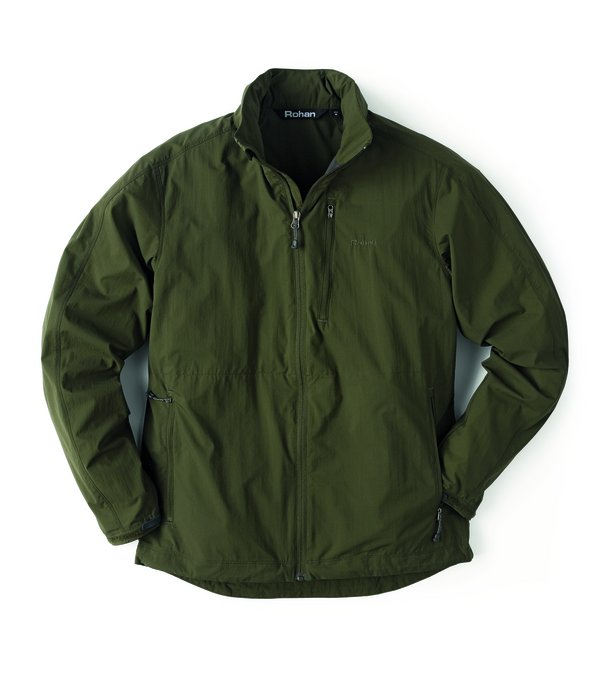
This summer I treated myself to a Rohan Windshadow in Trail Green.  It folds away in its own inside pocket and it works very well indeed. 


On days when it is simply raining all day then you will need a suitably coloured coat.  I still use a Barbour because I get involved with thorns on some of the rivers I frequent but there are other excellent jackets of more modern materials.  Yet again the colour is paramount if you are to have any chance at keeping your presence unknown to the fish. 

On those hot days when you will be wearing a shirt, don't forget that your arms may be the wrong colour for hiding from the fish, so wear long sleeves and choose materials that will defend you from nettles and such...

Well that's the clothes dealt with, next time we can start getting controversial with some tackle talk.  A subject to almost guarantee disagreement when discussed between two or more keen anglers.  No don't worry.  If you have already been fly fishing in still waters you will be surprised how much of your gear is perfectly usable for dry fly fishing on the rivers and streams.

Regular Rod

Tuesday, 7 December 2010

The Lines...

Click on the image to enlarge it and click again to get a closer look still
...are now available in WF3F, WF4F, WF5F, WF6F and WF7F.  They are the best quality possible today and are the only lines made specifically for the rigours of dry fly fishing, with no consideration towards other types of angling.  You can of course use them for other stuff, like wets and nymphs, but they are designed and built for dry fly fishing.

There has been no compromise made at all.  The best and latest core material was chosen, so memory won't spoil your first casts of the day.  The coating uses the finest glass balls, so the surface is as smooth as possible and yet the line floats really well.  The anti-friction content is a special material that doesn't cause a shine, so lets the lines be slick running through your rod's guides, yet still keep a dull finish to avoid flash, even in bright sunlight.  The brown colour is unique, being that of smooth, high organic content, MUD!  This has proven to be the best colour for avoiding the flicker and flash effect of pale coloured lines, as you make your false casts.  You will frighten fewer fish when casting this line.

The taper is especially designed to let you make accurate and delicate casts with only a very short amount of line through your tip ring.  In fact, during the trials, it proved easy to cast with just the weight of the line threaded up along the rod and no fly line actually outside the tip ring.  Then, when you need to make longer casts, the combination of the belly, the rear taper and the special anti-friction material in the coating lets you do this with ease and accuracy.  If you follow the advice about leaders, in the booklet, you will find even at long range your casts can turn over nicely and your presentations can still be delicate to help avoid scaring your fish.

The packaging is simple but attention to detail has been continued here as well.  The lines are bound with "pipe cleaners" rather than tapes.  The thought of a nearly fifty quid line being accidentally cut when snipping off tapes is too horrifying to bear.  Each line comes on a spool, so you do not risk kinking, knotting tangles when trying to get the line onto your reel.  It is a simple matter to push a pencil through the card insert in the spool and get someone to hold this "axle" whilst the spool turns as you load the line.  If you are doing this alone, simply make two small columns of books or magazines a couple of inches apart and trap each end of the pencil inside books opposite each other in the columns.  Then wind the line onto your reel whilst the spool turns between the two columns of books, or magazines. 

You will be pleased to note that each line has a label attached to the reel end of the line with the legend "ATTACH THIS END TO BACKING", which will save you from putting the line on the reel back to front.

How much?  £47 plus postage and packing.  These are lines that I vouch for personally and are guaranteed against any manufacturing defect.  If you would like one, drop me an email on dryflyexpert@sky.com telling me your requirements.

That's the end of the commercial break.  We'll finish off clothing in the next post and move onto... tackle.

Regular Rod

Monday, 6 December 2010

Getting down to the bottom of the subject

Where you, dear angler, are the "subject".

Last time we examined your head, so now we consider your other end.  What you wear on your lower reaches will depend on several considerations.  Will you be wading?  Will you be deeply wading?  (No not deeply wailing!  Save that for church.)  Or will you be fishing from the bank and only the bank.  In a dry summer it may be much more comfortable for the bank angler to leave the wellies behind and instead wear some outdoor boots.  I know some very successful dry fly anglers who wear chest high wading stockings in all conditions, even though they do not intend to wade.  They value the protection above the potential for cooking a little on warmer days.  These considerations are mainly down to where you will be fishing and your personal preferences, but...

Remember that your quarry must not be aware that you are there.  A low profile is most desirable.  To this end if you are not wading then the posture of your daily supplications can bring an answer to your prayers, but often, even better, being seated is the way to keep low yet still be able to cast and control your line reasonably well.  So on your knees, or on your backside, the matter of what you are wearing on your legs and lower loins becomes important.

If you have overtrousers that resist the onslaught of thorns, thistles, puddles and cow pats then your problems are solved more comfortably than with chest high wading stockings.  Mine are inexpensive, Goretex bib and brace style trousers with built in braces.  Ex-German or Dutch army, they cost about £30 and they are tough enough to last 5 seasons at least.  Whatever you do get, make sure you wear them even on hot days.  A pair of nice Rohan or Craghoppers outdoor trousers will be cool and comfortable until you start working your way through waist high nettles and thistles, then you will wish you had slipped the overtrousers over them before you decided to angle in places where the fish do not have a well worn path beaten to them.

This is mundane stuff but if you overlook these details it can spoil your chances and your comfort.  So please do take it seriously when you begin this toe-to-toe, creeping skulduggery we call dry fly fishing.

Regular Rod

Tuesday, 30 November 2010

"Clothes maketh man..."

They also maketh more successful anglers, especially anglers who must be stealthy for their branch of our wonderful Sport.  If you are coming to dry fly fishing from still water fly fishing you probably have perfectly suitable clobber already.  BUT there is a chance that you may need to watch out for the colours.  The lush vegetation by the side of a typical lowland river means that greenish hues rather than limestone "whites" will be more appropriate.  Darker shades seem to be the most useful, let cow pats be your inspiration rather than the High Street.

Clothes can contribute, or detract, from your ability to make use of the second and third basic principles for successful dry fly fishing, observation and stealth.  Let us begin at the top with the head.  Starting with the eyes.  Your polarised spectacles will be vital for fish spotting and protection from a wayward cast.  Mine are a very old pair of Optix Cormorants that are a pale grey and work well even in dim light.  Whatever sort you prefer, you can optimise the effectiveness of your polarised spectacles by wearing a hat with a full brim to shade them from behind as well as above.  This will let you see more clearly, in the same way a lens hood often improves the quality of photographs.


On a recent comment, Warren kindly put a link to a photograph he took that shows two pretty reasonable examples of good shape and good colours of hat to go for.


John's hat is a darker greenish olive of rabbit fur felt.  This is pretty good in cool weather and is okay in light rain too.  Mine is the khaki one in canvas duck that came from Orvis.  It needed modifying by covering the silly leather hat band with a strip of material, webbing in my case, so damp flies can be stuck into it.  That way they do not bring water into the fly boxes and rust all that hard work away... 


This hat has been superceded at Orvis by the River Guide Hat and sports a reinforced brim so you can shape it.  My advice would be to keep it shaped like an upside down dish to get the maximum shading effect for your polarised spec's.
You may like to obtain several hats to cope with the vagaries of weather, a dark green or brown straw hat maybe, for boiling hot days in summer; one of canvas duck for most days and maybe something waterproof, or at least water resistant for rainy days.  Just make sure that whatever you get, your hats should shade the back of your polaroids as well as the top and, most importantly, they are always as drab as you can get.


Well that's your head taken care of.  Next time trousers and how they also contribute to observation and stealth!


Regular Rod 

Wednesday, 24 November 2010

Migration...


John Neville in typical pose at Ladybower in the late 60's

...from still waters

"Whence come you?"
"The Lakes and Reservoirs!"
"Whither directing your course?"
"The rivers and streams!"
"What do you hope to find?"
"The true secrets of dry fly fishing!"

Of course they are not really secrets!  Nevertheless, there are some key differences from all the things you had to learn whilst fishing the Lakes and Reservoirs.  Having a go at dry fly fishing need not be a disappointing experience. 

Over the next few weeks we can consider some of the differences facing the many anglers who, having built up a treasury of experience on still waters, fancy getting to know, first hand, the joys of dry fly fishing on rivers and streams.

There are mainly 3 adjustments to make in a migration from still waters to dry fly rivers: 
  1. Clothes
  2. Tackle
  3. Approach
There!  Now that doesn't look too hard a list does it?  It need not be but we will take it on in easy stages just to make sure.  If you are fancying this migration do feel free to drop in a comment with any aspects of the move that concern you particularly and I will make sure we cover your points specifically.

Regular Rod