A few words and pictures for those who are or would like to be "expert" at dry fly fishing on rivers.
Sandbagged!
Photograph by Steve Barnett
Saturday, 24 May 2014
Victim Support?
Here's a fish that at first glance is not in great condition and to be avoided by any angler as we don't want to catch sickly fish. However, this is an exception that proves the rule. The poor condition is due to this fish having difficulty in feeding (I believe so anyway). Why can it not sustain itself? It was once a fine brown trout now it is losing condition before its time. What has gone wrong? Check out just in front of that pectoral fin. Can you see that pale beige line coming from the corner of the mouth? It's fishing line! It's been there a long time judging by the algae growing on it...
I want to catch this poor fish and take the hook out of its mouth, remove the impediment completely and let this fish have a go at regaining its condition through the summer. Can I catch it? Not unless I find it feeding at the surface first...
Regular Rod
Wednesday, 21 May 2014
Amadou - A Short Story in Pictures
Amadou is good stuff and well worth either the money or the hard work needed to obtain it. It is quick to use, which when Sport is brisk proves advantageous.
First get your fly wet.
Lay the wetted fly in the Amadou and press it firmly.
The water comes out of the fly into the Amadou, making a temporary "Water Fossil".
The fly is restored to "as new" condition, ready for you to get it wet again...
RR
First get your fly wet.
Lay the wetted fly in the Amadou and press it firmly.
The water comes out of the fly into the Amadou, making a temporary "Water Fossil".
The fly is restored to "as new" condition, ready for you to get it wet again...
RR
Sunday, 11 May 2014
"80 percent of success is just showing up..."
So claimed Woody Allen in an interview some years ago about his career.
Yesterday it was the turn of Peter, the Wild Trout Trust winner of the auction lot comprising a day's fishing in Duck Holds Wood, to prove that claim.
Only the day before I'd offered him the chance to literally take a rain check. I'm very glad he declined the offer, preferring to stick to our arrangement to meet at the Peacock in the morning and go to Duck Holds Wood together for a day of dry fly fishing.
We had a good time between rain showers. First we wandered together from the downstream limit up to the top limit and Peter opened up the day by catching a wild rainbow trout at the top end in the pool known as "Upper Eddies".
This coincided nicely with lunch time so back to the "fishing house" and some grub and a shared pot of Kelly Kettle tea and then, we split up so Peter could have some solitude whilst he worked his way slowly back up the river.

Your faithful correspondent went up river just past halfway, so that Peter would have plenty of undisturbed water to fish. It was a splendid fishing afternoon. Some fish seemed to be eating little beige sedge flies and accepted the Double Badger with enthusiasm; then there were those preferring some unidentified olives that ate the Grey Duster with similar gusto, the best of these for your blogger was a brown trout under the near bank about 8 inches from the edge under a tussock of healthy overhanging nettles. Then, as the wind strengthened and the sky became leaden, the river was suddenly dotted with unfortunate Hawthorne flies that were ditched in the drink by the sudden squalls. The light was such that the black flies showed up very well and so did the fish when they wolfed them down. On with Charles Cotton's Black Fly and the Sport continued.
A mobile 'phone call about a crisis at home meant that Peter had to get back so we packed up just before four o'clock, sad to be ending the fishing but happy with the results achieved and the whole occasion of fishing in this special place. It was good to meet and fish with a kindred soul and we both look forward to some future meeting beside any of these glorious Derbyshire streams.
I later learned that, on other parts of the river, hardly anyone had ventured out to fish yesterday. Peter's preference meant that we did. 80 percent of our work was done by this decision and we were there to reap the rewards.
(As ever, simply click on a picture if you would like a closer and clearer look...)
Regular Rod
Yesterday it was the turn of Peter, the Wild Trout Trust winner of the auction lot comprising a day's fishing in Duck Holds Wood, to prove that claim.
Only the day before I'd offered him the chance to literally take a rain check. I'm very glad he declined the offer, preferring to stick to our arrangement to meet at the Peacock in the morning and go to Duck Holds Wood together for a day of dry fly fishing.
We had a good time between rain showers. First we wandered together from the downstream limit up to the top limit and Peter opened up the day by catching a wild rainbow trout at the top end in the pool known as "Upper Eddies".
![]() |
| Peter into a Derbyshire Wye Wild Rainbow Trout at "Upper Eddies" |

Your faithful correspondent went up river just past halfway, so that Peter would have plenty of undisturbed water to fish. It was a splendid fishing afternoon. Some fish seemed to be eating little beige sedge flies and accepted the Double Badger with enthusiasm; then there were those preferring some unidentified olives that ate the Grey Duster with similar gusto, the best of these for your blogger was a brown trout under the near bank about 8 inches from the edge under a tussock of healthy overhanging nettles. Then, as the wind strengthened and the sky became leaden, the river was suddenly dotted with unfortunate Hawthorne flies that were ditched in the drink by the sudden squalls. The light was such that the black flies showed up very well and so did the fish when they wolfed them down. On with Charles Cotton's Black Fly and the Sport continued.A mobile 'phone call about a crisis at home meant that Peter had to get back so we packed up just before four o'clock, sad to be ending the fishing but happy with the results achieved and the whole occasion of fishing in this special place. It was good to meet and fish with a kindred soul and we both look forward to some future meeting beside any of these glorious Derbyshire streams.
I later learned that, on other parts of the river, hardly anyone had ventured out to fish yesterday. Peter's preference meant that we did. 80 percent of our work was done by this decision and we were there to reap the rewards.
(As ever, simply click on a picture if you would like a closer and clearer look...)
Regular Rod
Wednesday, 2 April 2014
All Fool's Day 2014
Can you remember what your faithful blogger endured last season on this auspicious date?
Snow, cold winds and frosts with Snowdrops out in full bloom almost three months late!
2014 and what a difference!
Bright sunshine, Lesser Celandines instead of Snowdrops, warm gentle breezes, almost flat calm really, fly life busy, there were even butterflies around...
This Peacock only posed enough for a long focus grab shot but at least it was out and active along with Brimstones and others.
The trout were plentiful too and happy to eat my Double Badger with alacrity.
The only sad aspect to the day was seeing, once again, the permanent damage done by hydro-power to any river or stream where the greedy, thoughtless developers get to put it. There is nothing green about hydro-power. It does more damage than any other method of making electricity and what makes the blood boil is knowing that, in the UK, it is paid for with our taxes.
This is part of a depleted reach where once the water flowed generously between abundant beds of Ranunculus fluitans populated by hundreds of trout. Now it is, as you can see, a brown desert, devoid of plant life and so almost empty of fish.
Here's the problem. The main body of water is stolen from the river and diverted through a fish mincing turbine. That main body of water is then discharged into a side channel (seen on the left of this picture) and it flows back into the river, where once the biggest (and best) trout in Derbyshire used to live. They have all gone now along with the water plants. The photograph at the head of this blog can never be repeated all thanks to the hydro thieves and carpet baggers.
It was good to be out fishing with the dry fly again but it could all be so much better if folk were not so greedy and careless.
Regular Rod
Friday, 28 March 2014
A Unique Sight in the UK...
...Wild Rainbow Trout spawning in the Derbyshire Wye.
Yesterday I scared them off with my clumsy approach.
Today the sun was in my favour and I hid behind a tree...
Click the pictures for a closer look. Forgive the quality I only had the pocket camera handy.
Regular Rod
Yesterday I scared them off with my clumsy approach.
Today the sun was in my favour and I hid behind a tree...
Click the pictures for a closer look. Forgive the quality I only had the pocket camera handy.
Regular Rod
Tuesday, 18 March 2014
Split!
Here's another Crack Willow (Salix fragilis) that suffered in the recent storms. It's been there for about 400 years. It has survived at least 400 fierce storms before, but this winter they have been extraordinary in their strength. So here is what remains of the last willow on the right bank of the Derbyshire Wye. I think there is a chance that it may be left this year to see how it might work some magic in the river bed. It isn't dead yet so fresh shoots are likely to grow and it could even change the shape and nature of the Junction Pool just below it.
I love willows. In Great Britain only Oaks support more species than the willow. Willows are "givers".
RR
Wednesday, 12 March 2014
Preparation...
Walked over the hill with Henry to visit the Lathkill and see how things are coming on for All Fool's Day. It was a delightful 4 miles or so with only a short section on tarmac.
Henry of course was as investigative as ever and at each field entrance along the lanes the routine was a quick dash in, nose down, stop and sit at the signal from the whistle and then a scurry back to heel for all of five or six seconds! My word, tractor tyres seem to be getting very wide these days, even up here in the Peak District.
"What's all this mess?" you might be wondering? It's not a mess it's work in progress... (You can't make omelettes without breaking eggs!)
The fishing hut is in the process of being given a new lease of life by Warren and Jan. Fresh roof, old shutters removed, all much brighter. There is something rather secure and comforting in being dry inside on a rainy day, watching the river and sky whilst listening to the rain pattering on a corrugated roof. Pleasures to look forward to but hopefully not too many times this season. Sunshine will also be welcome.
The hut undergoing some close season "Preparation". Do you notice something else in this picture?
Click for a closer look...
What about the clarity of that water?
Yes even the river itself seems to have been in "Preparation" for the new season. It is as clear as gin...
Regular Rod
Saturday, 22 February 2014
Amazing New World Order addendum...
Some of you will already be aware that your faithful blogger is working on a series of photographs about Derbyshire's river Wye. These are being made with a variety of cameras using film rather than megapixels. By the confluence of the Wye with the Derwent there is an ancient willow, the last on the true right bank before the Wye ends and the Derwent takes over. This once fine tree has been split right down to the soil line by this month's storms.
This dramatically weather-hewn willow caught the eye so comprehensively that all the sheets of film were quickly used up in a frenzy of setting up the camera and tripod making an exposure then moving the whole lot to another location near this astonishing sight and another and another and so on and then, as if by magic, all the film was gone.
Henry was relieved as all was repacked away and we could move on. Naturally we had to go and have a little look down at the Derwent. Here was what must be destined to be a popular pool for the lucky new members of the Rowsley section of the Peacock Fly Fishing Club, the length immediately down river of the Junction Pool. The ground had some very healthy looking clumps of snowdrops dotted about it. River silts from the regular floods must be exactly what snowdrops like because these specimens were perfect in every respect and looked simply lovely.
You will all know the old saying, "The things you see when you don't have your gun!"
Oh why had all the film gone? Why not even one sheet left (preferably colour)? Never mind. The little Olympus was in the trouser pocket and a couple of digital snaps were made. Here's one of them.
Then on a piece of weathered wood what was that crawling along? By Gum! A February Red making the most of the sunshine after all the rain we have had in recent weeks. A quick snap and here it is.
Then it flew up and over the water, whereupon a gust of wind knocked it to the surface. It righted itself and seemed ready to take to the air once more then - BAM! A brown trout made a noisy meal of it.
Guess who has made a note of its whereabouts...
Maybe trout and blogger will get acquainted some time early in the season?
I'd say there was a very good chance, if some tardy February Reds are still around come All Fool's Day.
Regular Rod
This dramatically weather-hewn willow caught the eye so comprehensively that all the sheets of film were quickly used up in a frenzy of setting up the camera and tripod making an exposure then moving the whole lot to another location near this astonishing sight and another and another and so on and then, as if by magic, all the film was gone.
Henry was relieved as all was repacked away and we could move on. Naturally we had to go and have a little look down at the Derwent. Here was what must be destined to be a popular pool for the lucky new members of the Rowsley section of the Peacock Fly Fishing Club, the length immediately down river of the Junction Pool. The ground had some very healthy looking clumps of snowdrops dotted about it. River silts from the regular floods must be exactly what snowdrops like because these specimens were perfect in every respect and looked simply lovely.
You will all know the old saying, "The things you see when you don't have your gun!"
Oh why had all the film gone? Why not even one sheet left (preferably colour)? Never mind. The little Olympus was in the trouser pocket and a couple of digital snaps were made. Here's one of them.
![]() |
| Snowdrops 'neath the Junction Pool |
Then on a piece of weathered wood what was that crawling along? By Gum! A February Red making the most of the sunshine after all the rain we have had in recent weeks. A quick snap and here it is.
![]() |
| February Red |
Guess who has made a note of its whereabouts...
Maybe trout and blogger will get acquainted some time early in the season?
I'd say there was a very good chance, if some tardy February Reds are still around come All Fool's Day.
Regular Rod
Tuesday, 18 February 2014
Amazing New World Order!
You will have noticed that this is not a commercialised
blog. That is so that if anything is
recommended on here, you can be sure there is no ulterior motive and that what
is being recommended has, in your blogger’s opinion, great merit. This (rather long) post is all about one such thing, a new
fly fishing club with astonishingly good fishing for its lucky new members.

The Haddon Estate has brought its four miles or so of the
Derbyshire Derwent back in-hand. These are
now added to the eight miles of the Derbyshire Wye, two miles plus of the
Lathkill and all of the river Bradford under the gentle management of the
fisheries department of the Estate. In
recent years, as well as fantastic fishing, thanks to its husbandry policy of
habitat creation, restoration, and preservation, it has also meant more and
easier access for anglers to the Estate’s excellent fishing via membership of
the Peacock Fly Fishing Club based at the Peacock Hotel in Rowsley.
Now, with the addition of the Derwent fishing, the club is further enhanced
with the Rowsley Fly Fishing section.
Subscriptions for the various memberships available are very competitive
and there is no joining fee!
Waters, which when your faithful blogger started fly fishing were
exclusively available to the wealthy and well connected, are now available to
all of us to enjoy simply by joining this new club. You can get all the details, if you fancy a
rod here, by contacting the Peacock at Rowsley.
www.thepeacockatrowsley.com
or call 01629 733518.
Not so very long ago it was just about impossible for the
ordinary angler to gain access to some of the World’s finest dry fly
fishing. There was, however, one little
chink of encouraging light in the darkness of despair at ever being allowed on
such hallowed waters. This was the day
ticket water on the Haddon Estate’s length of the Derbyshire Wye, the famous
“Peacock Water” so named because the Peacock Hotel at Rowsley was where we went
to buy our tickets. It is where anglers
still congregate, where visitors can still have a day ticket to treat
themselves to what is usually a special day after the wild brown trout and grayling,
with the added bonus of the Wye’s wild rainbow trout, this being the only river
in England with a self-sustaining head of rainbow trout whose first encounter
with Homo sapiens sapiens is when
they meet a lucky angler!
In 1969 your faithful correspondent fished the “Peacock
Water” on a day ticket for the first time and soon after became a regular rod. The Derbyshire Wye was once more the Mother
river to yet another of her keen tyros.
She taught this one everything he now thinks he knows about dry fly
fishing, lessons learnt that have been applied with not a little success on
waters North, South, East and West, near and far.
Over time, as spending power increased and the distance of
my name from the top of the waiting list shortened, it became possible to join
the syndicate to fish an additional river, a tributary of the Wye. This was the Lathkill, made famous by Charles
Cotton in the fifth edition of the Complete Angler, when he described the
waters as the clearest he had ever seen and that the trouts were said to be
“the reddest in all England”. The
Lathkill, for observant and thinking anglers, imposes more advanced lessons on
the subjects of concealment from the fish and of fly presentation. Clumsiness on here is not quickly forgiven by
the fish.
There was another syndicate further up the catchment on the
little river Bradford, which is a miniature version of the Lathkill and
tributary to it. Here there are even
more of those amazing red coloured wild brown trout. The red pigmentation is unique for this gene
pool . If you painted a picture of one
accurately folks would think you insane.
Here the fishing was again a test of stealth but somehow the Sport was a
little easier. Visits to the Bradford
for your blogger were only made as a privileged guest and nicely added to the
variety which is supposed to be the spice of life.
It was also as an occasional and very privileged guest, of
the owner, that the delights of the Haddon Estate’s four miles of the
Derbyshire Derwent were sampled. These
delights are different from those of the Wye and her tributaries, in that
wading is the order of the day here. The
banks of the Derwent are steep and high, typical of a spate river that is
mainly rain-fed, so it is on with the waders and in you go. Here the wet fly is permitted as well as the
dry fly, which makes it a much desired water by anglers who like to practise
the submerged and semi-submerged disciplines in the art of fly fishing. There is something to suit everyone. Access to these waters was exclusively
available only to members of a club, which leased the waters from the
Estate. The quality of the fishing here
meant that membership was keenly sought no matter the cost or the several years
in Limbo with your name on the lengthy list of other anglers’ names all waiting
for dead men’s shoes. If your name came
up you had to be ready with a hefty, non-returnable, joining fee plus your
subscription money for your first year.
True to the famous quote from Heraclitus, an Ancient Greek
philosopher, “Change is the only constant in life”, things have changed and
changed for the better as far as we ordinary anglers are concerned.

![]() |
| The "Junction Pool" - Coming in from the left is the Derbyshire Wye to join the Derwent near Rowsley |
![]() |
The Record Book in the Lounge at the Peacock the "Finest Fishing Hut that Ever There Was!"
|
Yes it’s an Amazing New World Order, but one thing hasn’t
changed...
You can still buy a day ticket from the Peacock Hotel and
fish the Derbyshire Wye!
Regular Rod
Saturday, 8 February 2014
The Best Badger Capes I have seen...
....in the last twenty years. I fact I think they might be the best I've seen ever!
Thank Heavens that the British Fly Fair International event has at last reverted to the close season. Many of us have missed these excellent occasions recently because they were during one of the nicest parts of the Trout Season. Fishing takes priority over shows for your faithful blogger and dry fly fishing takes priority over just about anything so the shows were a long way off the agenda. Now we are back to the happy state of being able to engage in retail therapy to keep us from depression as we wait for the trout season to start again. Thanks to "being there" today a fantastic opportunity was not missed...
Six or seven years ago at the Game Fair, your correspondent was engaged in an educational conversation with Christina Tooley of Chevron Hackles. She explained that she was engaged in a programme of breeding cockerels with badger marked capes. She had some success but at that time was stuck in the paradox of what to do with the best birds. Kill them and sell their skins? Or keep them in the programme to benefit from the input of their genes? She chose wisely if the experience today was anything to go by.
Imagine the disappointment earlier today when schlepping around the show, searching every sales point for good quality badger cock capes, but finding nothing anywhere near what was desired. It looked like it was going to be another failed attempt to find these very important capes. Imagine the slight lift in optimism on arriving at, then scanning the Chevron Hackles stand and spying what looked like a properly marked badger cock cape up on the rack. Consider the further elevation in spirits when realising that there were actually 10 or more of these capes on the rack...
Trying to look calm and unflustered the whole rack was taken down and one-by-one, each cape was carefully removed from its clip-lock bag, examined carefully, returned to the bag and either returned to the rack or retained in the grip of the third and fourth fingers of the right hand whilst the inspection continued.
"You've cracked it! You've definitely cracked it! These are perfect! I'll have these three please..."
The rest were returned to the display for the next lucky fly tier to find. Frankly. if the money was available, none would have gone back on display. They are all that good!
Normally I wouldn't recommend buying capes unseen and unexamined, but if you cannot get to the BFFI Fly Fair tomorrow, (Sunday 9th February) http://www.bffi.co.uk/ then you could do a lot worse than to contact Christina via chevronhackles@yahoo.co.uk and ask her to supply you with badger cock capes like the ones bought today by Regular Rod...
Regular Rod
![]() |
| From left to right, Grade One, Grade Two, Grade Three! |
Six or seven years ago at the Game Fair, your correspondent was engaged in an educational conversation with Christina Tooley of Chevron Hackles. She explained that she was engaged in a programme of breeding cockerels with badger marked capes. She had some success but at that time was stuck in the paradox of what to do with the best birds. Kill them and sell their skins? Or keep them in the programme to benefit from the input of their genes? She chose wisely if the experience today was anything to go by.
Imagine the disappointment earlier today when schlepping around the show, searching every sales point for good quality badger cock capes, but finding nothing anywhere near what was desired. It looked like it was going to be another failed attempt to find these very important capes. Imagine the slight lift in optimism on arriving at, then scanning the Chevron Hackles stand and spying what looked like a properly marked badger cock cape up on the rack. Consider the further elevation in spirits when realising that there were actually 10 or more of these capes on the rack...
Trying to look calm and unflustered the whole rack was taken down and one-by-one, each cape was carefully removed from its clip-lock bag, examined carefully, returned to the bag and either returned to the rack or retained in the grip of the third and fourth fingers of the right hand whilst the inspection continued.
"You've cracked it! You've definitely cracked it! These are perfect! I'll have these three please..."
The rest were returned to the display for the next lucky fly tier to find. Frankly. if the money was available, none would have gone back on display. They are all that good!
Normally I wouldn't recommend buying capes unseen and unexamined, but if you cannot get to the BFFI Fly Fair tomorrow, (Sunday 9th February) http://www.bffi.co.uk/ then you could do a lot worse than to contact Christina via chevronhackles@yahoo.co.uk and ask her to supply you with badger cock capes like the ones bought today by Regular Rod...
Regular Rod
Wednesday, 29 January 2014
Our last day of the ....
... shooting season.
Whilst the river is never long out of my mind and Henry and I walk by it on most days for some of its length, our Saturdays over winter have been spent picking up at a couple of shoots. This Saturday just gone was our last day until next season. No doubt Henry and your faithful blogger will be spending more time near the water from now on and he will have to be very patient again whilst tripod and camera are fiddled with for hours on end.
Here he is on the last day with a hen pheasant that reminded me more of a bumble bee than a bird. It was so small, it was a wonder the gun managed to hit it!
Normal service will be resumed as soon as possible when a return to matters riverine will be duly effected...
Regular Rod
Thursday, 16 January 2014
Please Help This Project...
Here is a link to a Kickstarter Project that the world needs not just the UK. The most amazing wildlife has been filmed all over the world and yet here in the UK we have species that have hardly ever been filmed and some that have never been filmed. Why? Well, simply put, they are out of sight and therefore out of mind. And why is that? It's because they are FISH.
Remember some of my feeble attempts to video fish in their habitat with a hand-held, waterproof, point and shoot camera set on video?
and
Well Jack Perks is a real master at underwater filming of fish in their natural habitat (not tanks) and you can rely on him to make a perfect job. His project has the potential to do a great deal of good. Especially when we try to persuade those who rule over us to consider the needs of fish when making decisions about weirs, hydro-power, sewage treatment, abstraction, land use, pollution, flood "prevention" et al. It doesn't cost a lot to make this project happen. Please have a look and pledge what you can. Every contribution helps and yours might be the very one that triggered the project's coming to life.
Thank you.
RR
Tuesday, 7 January 2014
Rain and more Rain, the Lifeblood of the Countryside.
Do you like to see the winterbournes running and all the springs welling up to fill the rivers, level off the obstructions and make it a little easier for the fish to run up stream?
So do I. Springs, in particular, can be so beautiful.
Here's one by the side of the Derbyshire Wye. It even has its own miniature world of ferns, ivy leaves and mosses supported by the bounteous gushing that disappears again under the ground to pour out into the river proper a few yards away.
What's this got to do with Dry Fly Fishing?
To me?
Everything...
Regular Rod
So do I. Springs, in particular, can be so beautiful.
![]() |
| Click the Pic for a closer look |
Here's one by the side of the Derbyshire Wye. It even has its own miniature world of ferns, ivy leaves and mosses supported by the bounteous gushing that disappears again under the ground to pour out into the river proper a few yards away.
What's this got to do with Dry Fly Fishing?
To me?
Everything...
Regular Rod
Monday, 23 December 2013
Season's Greetings
From Regular Rod (it's a snap of Bakewell by the Derbyshire Wye)
and from Henry (he wears his hair shorter nowadays...)
Regular Rod
and from Henry (he wears his hair shorter nowadays...)
Friday, 20 December 2013
Pop Up?
We had some gales a few weeks ago. Several trees were blown down. I wish they were all those dreadful aliens, the sycamores! No, instead native willows have been the "victims".
Do you remember this picture?
See the big willow on the left? That was a favourite place for me to sit cross legged on the willow's roots and side-cast up to the fish on station in the various feed lanes below the weir's lasher. It was low down and it was easy to be inconspicuous down there below the sky line.
Now look what has happened. The willow was blown down. Jan managed to get some of it to pop up again by sawing off lengths of trunk until the weight of the root ball was sufficient to drag what's left of the willow back to an upright position.
Instead of a nice little hidey-hole to sit in, the roots are now a pulpit! It will be tricky to fish there and not be noticed.
It's not all gloom and doom though. Jan has saved the tree from total extinction and the trunk will make a splendid pollard in a few months and eventually it will boast a fine Afro-hairstyle like a massive pompom on a stick. The flies will still land on its leaves to rest and change their skins. The wren will still creep around those leaves grabbing some of those flies. A fish may even take up residence under the overhang made by the now airborne roots...
This isn't the first tree to be salvaged by the keepers in making it... Pop Up!
Regular Rod
Do you remember this picture?
![]() |
| Black Barn Weir Pool |
![]() |
| Enough space to sit cross-legged |
![]() |
| Sitting cross-legged and using the waterproof trousers as an unhooking mat |
![]() |
| Click the pictures for a closer look... |
Now look what has happened. The willow was blown down. Jan managed to get some of it to pop up again by sawing off lengths of trunk until the weight of the root ball was sufficient to drag what's left of the willow back to an upright position.
Instead of a nice little hidey-hole to sit in, the roots are now a pulpit! It will be tricky to fish there and not be noticed.
It's not all gloom and doom though. Jan has saved the tree from total extinction and the trunk will make a splendid pollard in a few months and eventually it will boast a fine Afro-hairstyle like a massive pompom on a stick. The flies will still land on its leaves to rest and change their skins. The wren will still creep around those leaves grabbing some of those flies. A fish may even take up residence under the overhang made by the now airborne roots...
This isn't the first tree to be salvaged by the keepers in making it... Pop Up!
Regular Rod
Monday, 16 December 2013
Different but the same...
My mother river, the Derbyshire Wye, which taught me so much about dry fly fishing, is said to be only 15 miles long. In that 15 miles it changes from a moorland trickle of surface water, constantly dripping out of the blackest cauldron of peat you could imagine, to a splendid, limestone, spring-fed river full of life and beauty. I usually fish along the last few miles, where the land is fat and the river is a peaceful thing, meandering through the almost level pastureland between Bakewell and Great Rowsley. A few miles upriver the scene is quite different. The surroundings are steep sided "Dales". On several occasions I have had the privilege of fishing up here as a very honoured guest and it is a delightful place to be. There is a footpath open to the public alongside its true left bank and from time to time, in winter, I like to wander along here with a camera. Last week, hoping to aid recovery following some minor surgery, I went on such a walk and fell in love with this piece of large woody debris. A photograph simply had to be made in homage to the power of the river and this now dead, but still useful, tree.
What do you reckon to it?
RR
![]() |
| The Derbyshire Wye in Miller's Dale |
RR
Wednesday, 13 November 2013
How to Whip Finish Your Flies
How to never lose your whip finish tools? Keep them attached to your hands! That way you can always find them.
1) Hold the thread downwards in tension with your left hand (opposite if you are a southpaw)
2) Place your first two fingers of your other hand onto the tensioned thread, backs of the fingers to you
3) Lift the thread in the left hand, still in tension, up level to the fly, turn the right hand so the underside of the fingers face you
4) Keep the thread in tension with the left hand holding the thread in line with the hook shank, this makes a kind of inverted figure four "4"
5) Use the fingers of the right hand to turn the thread over the hook shank behind the eye and over the thread alongside the hook shank
6) Repeat for as many turns as you require
7) Trap the thread against the hook shank with the left first finger
8) Remove your right fingers from the loop
9) Take a needle and hold the loop in tension with the needle
10) Draw the thread tight slipping out the needle as the thread pulls tight, cut off the spare thread and Voila!
...the whip finish
Tuesday, 5 November 2013
Hand of Man or Hand of God?
You will no doubt recall that your faithful blogger has been know to interfere with Nature sometimes... You might like to consider two examples of locally changing the way the water works in a river.
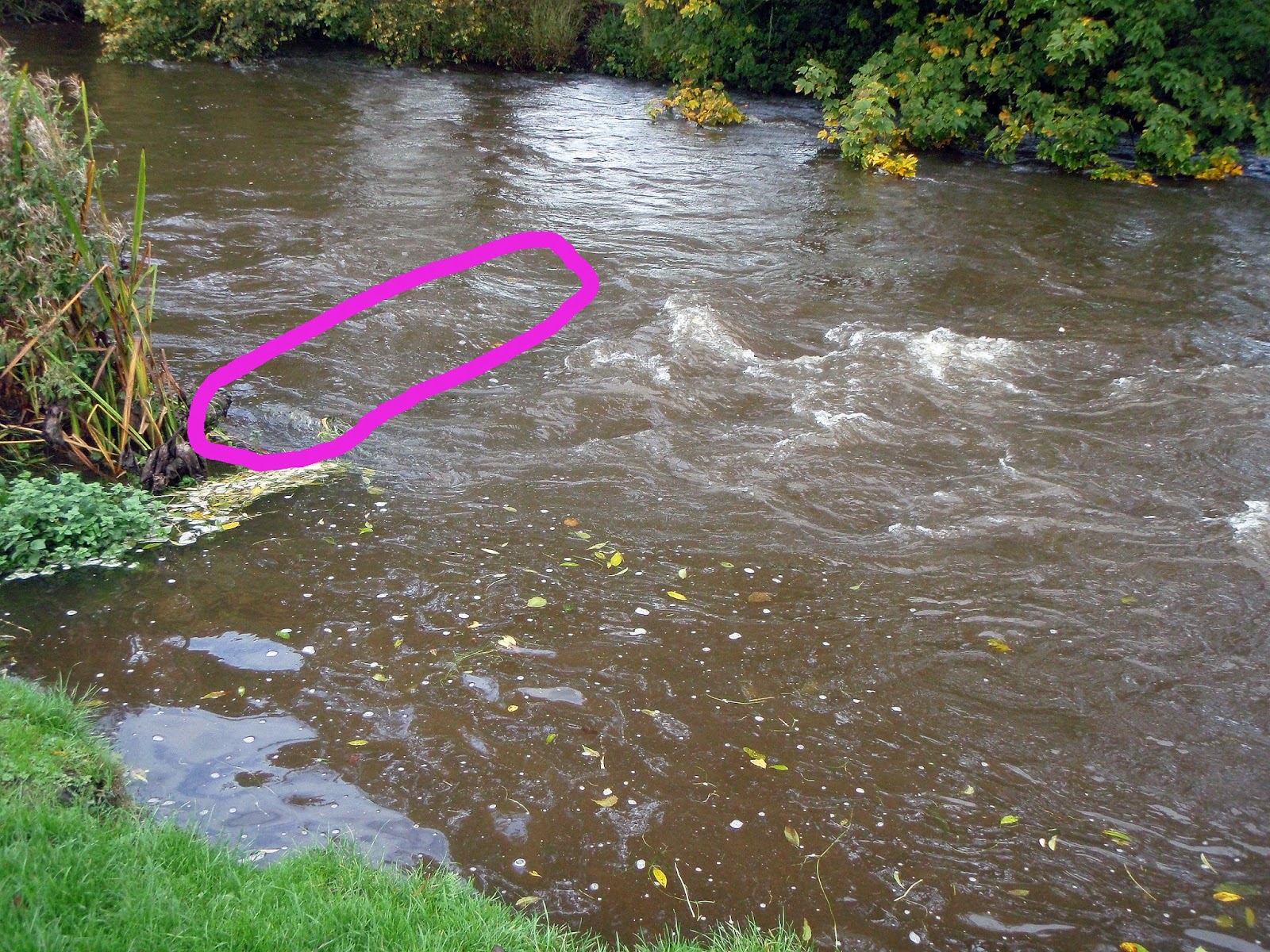
The first came about when the waders had been donned after the season to clear some rubbish from the river. Discarded plastic bags are an abomination and so it was decided to get in and get them out. The opportunity to try something to augment the effect of a little peninsula was just too tempting. Twenty minutes of picking up stones and placing them in a line resulted in a submerged cobble croy. about nine inches high and about four feet long. The croy was angled to point diagonally up river and even in low water conditions it could be seen that it had an immediate effect. There was a nice crease in the current running downstream for quite a few yards from the croy. This also created a longer eddy than was previously formed by the little peninsula alone. The hope was that this would increase the fish holding properties just here, especially in high water.
Well it seems to have worked quite well. This video below shows you how it is working in high water. The leaves drifting on the surface let you see the upriver direction of the eddy between this bank and the main current. Yes it is interference and it was done for selfish reasons, to persuade more fish to take up station here. Hopefully you will not think ill of your correspondent. It was a well intended act and if it spoils anything, it can be shifted...
How about when God locally changes the way the water is working?
We had some storms recently and this big Weeping Willow was pruned somewhat as you can see by the below picture...
Down river the, rather large, bough came to rest at the tail of a pool below a large island. I hope it stays there! Just look at how it is already causing the flow to scour away at the gravel.
The river bed rises here a little and might be just what the bigger female trout may want for a new place to make redds and wait for husbands around Christmas time.
The danger trout face when on the redds comes from piscivorous birds. On some redds they are easy prey, with nowhere to escape to nearby. Those trailing branches and fronds of willow are perfectly placed nearby to the newly cleaned gravel for just such emergency escape routes.
So here we have a couple of local changes to the river, its flow and its bed. Of the two I have a strong feeling that this one made by God will be much more productive and longer lasting...
That is unless someone interferes and pulls out the willow bough!
Regular Rod
The first came about when the waders had been donned after the season to clear some rubbish from the river. Discarded plastic bags are an abomination and so it was decided to get in and get them out. The opportunity to try something to augment the effect of a little peninsula was just too tempting. Twenty minutes of picking up stones and placing them in a line resulted in a submerged cobble croy. about nine inches high and about four feet long. The croy was angled to point diagonally up river and even in low water conditions it could be seen that it had an immediate effect. There was a nice crease in the current running downstream for quite a few yards from the croy. This also created a longer eddy than was previously formed by the little peninsula alone. The hope was that this would increase the fish holding properties just here, especially in high water.
![]() |
| The pink line is where the stone croy lies under the water. |
![]() |
| Here you can see the hump in the water cause by the croy and the crease line between the main flow and the eddy at our feet |
How about when God locally changes the way the water is working?
We had some storms recently and this big Weeping Willow was pruned somewhat as you can see by the below picture...
Down river the, rather large, bough came to rest at the tail of a pool below a large island. I hope it stays there! Just look at how it is already causing the flow to scour away at the gravel.
The river bed rises here a little and might be just what the bigger female trout may want for a new place to make redds and wait for husbands around Christmas time.
The danger trout face when on the redds comes from piscivorous birds. On some redds they are easy prey, with nowhere to escape to nearby. Those trailing branches and fronds of willow are perfectly placed nearby to the newly cleaned gravel for just such emergency escape routes.
So here we have a couple of local changes to the river, its flow and its bed. Of the two I have a strong feeling that this one made by God will be much more productive and longer lasting...
That is unless someone interferes and pulls out the willow bough!
Regular Rod
Subscribe to:
Posts (Atom)